
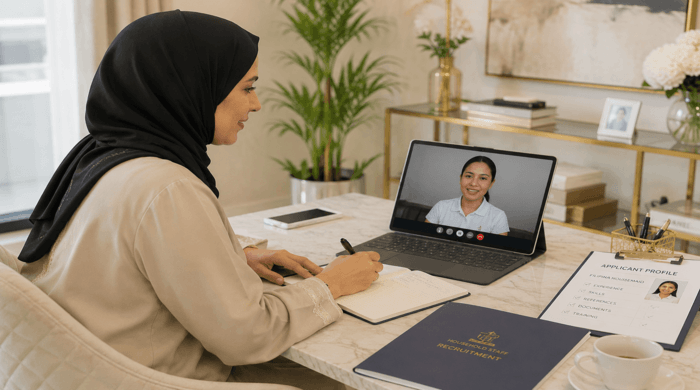
Hiring a domestic worker is an important decision for any family.
While candidate profiles and experience summaries provide useful information, they do not always present the complete picture.
An interview allows families to learn more about a candidate's communication style, practical experience, personality, and suitability for the household.
Many hiring mistakes happen because families do not ask the right questions during the interview.
A well-planned interview helps clarify expectations, identify strengths, and support better hiring decisions.
In this guide, you'll learn how to conduct an effective domestic worker interview and choose the right candidate for your home in Kuwait.
🏠 Why the Interview Matters More Than Many Families Realize
A candidate profile explains previous experience and responsibilities, but it cannot fully show personality or communication skills.
An interview helps families:
- Verify profile information.
- Understand practical experience.
- Assess communication skills.
- Clarify expectations.
- Evaluate overall compatibility.
Even candidates with similar profiles may perform very differently during an interview.
For that reason, the interview should be treated as an essential part of the hiring process.
📋 Prepare Before Asking Questions
One of the most common mistakes families make is conducting interviews without proper preparation.
🔹 Define Your Household Needs First
Before speaking with any candidate, define your household's priorities.
Ask yourself:
- Do you need childcare support?
- Is cooking an important responsibility?
- Are housekeeping duties the main focus?
- Will the candidate assist elderly family members?
Clear priorities make it much easier to compare candidates fairly.
🔹 Create a Consistent Interview Approach
If you are interviewing multiple candidates, asking similar questions helps make comparisons more objective.
This reduces the likelihood of making decisions based solely on first impressions.
💡 Practical Tip
Prepare a short list of essential questions before every interview and use it consistently with all candidates.
🎯 Ask Questions About Previous Work Experience
A candidate's experience is important, but an interview allows you to understand it in greater detail.
🔹 What Type of Households Have You Worked In?
This question helps families understand whether the candidate has experience in environments similar to their own.
For example:
- Large households
- Small families
- Homes with children
- Homes with elderly family members
🔹 What Were Your Main Responsibilities?
Encourage candidates to explain their daily tasks rather than simply listing skills.
Detailed answers often provide a clearer picture of practical experience.
🔹 What Was the Most Challenging Part of Your Previous Job?
This question may reveal problem-solving abilities, adaptability, and work experience in real situations.
👶 Questions About Childcare Experience
For families with children, childcare experience may be a major factor in the hiring decision.
🔹 What Ages of Children Have You Cared For?
Experience with infants may differ significantly from experience with school-age children.
🔹 What Childcare Responsibilities Did You Handle?
Look for specific examples, including:
- Feeding children
- School preparation
- Supervising activities
- Managing daily routines
🔹 How Do You Respond When a Child Refuses Instructions?
This type of question helps families understand the candidate’s approach to communication and child supervision.
🍽️ Questions About Cooking and Household Duties
Every household has different expectations regarding domestic responsibilities.
🔹 What Types of Meals Have You Prepared Previously?
This helps determine whether the candidate's experience aligns with your household's needs.
🔹 Which Household Tasks Are You Most Comfortable Handling?
Candidates often have strengths in particular areas.
Understanding these strengths helps families make better decisions.
🔹 How Do You Organize Your Daily Work?
This question provides insight into time management and organizational skills.
🗣️ Evaluate Communication Skills During the Interview
Good communication is essential in every household.
🔹 Pay Attention to Understanding
Observe how easily the candidate understands questions and instructions.
🔹 Look Beyond Perfect Language
Fluency is not always necessary.
What matters most is the ability to understand and communicate clearly.
🔹 Encourage Open Conversation
Candidates often provide more useful information when they feel comfortable speaking openly.
💡 Remember
The interview itself is often one of the best ways to assess communication abilities.
⚖️ Discuss Daily Routines and Expectations
The interview is an excellent opportunity to establish clarity.
🔹 Explain Your Household Routine
Describe your typical daily schedule and expectations.
🔹 Discuss Working Preferences
Discuss topics such as:
- Daily responsibilities
- Childcare requirements
- Household priorities
- Communication expectations
🔹 Confirm Understanding
Encourage candidates to ask questions and clarify any uncertainties.
Clear expectations reduce misunderstandings later.
🚩 Warning Signs Families Should Not Ignore
Interviews often reveal important information that may not appear in profiles.
🚩 Very Vague Answers
Candidates who struggle to explain previous responsibilities may require additional questions.
🚩 Inconsistent Information
Differences between profile information and interview responses should be clarified.
🚩 Lack of Interest or Engagement
A candidate who appears completely disengaged may not be a good match for a long-term position.
🚩 Unclear Understanding of Responsibilities
If expectations remain unclear after discussion, further clarification may be necessary before proceeding.
These signs do not automatically indicate a poor candidate, but they deserve attention.
🤝 Create a Comfortable and Respectful Interview Environment
The quality of an interview often depends on the environment in which it takes place.
🔹 Encourage Honest Conversation
Candidates are more likely to provide useful information when they feel comfortable.
🔹 Avoid Turning the Interview into an Interrogation
The goal is to understand the candidate, not simply test her.
🔹 Show Respect and Professionalism
A respectful interview often leads to more productive discussions and better decision-making.
📊 How to Compare Candidates After the Interview
After completing all interviews, compare candidates using the same evaluation method.
🔹 Review Notes Immediately
Document key observations while they are still fresh.
🔹 Compare Candidates Using Consistent Criteria
Consider:
- Relevant experience
- Childcare background
- Communication abilities
- Household skills
- Overall compatibility
🔹 Focus on Suitability Rather Than Perfection
The best candidate is usually the one who fits your family's needs most effectively.
✅ Making the Final Decision
Before making your final decision, ask yourself:
✔ Does the candidate understand our household's needs?
✔ Is the experience relevant?
✔ Were the answers clear and consistent?
✔ Does the candidate appear adaptable and willing to learn?
✔ Will this person fit comfortably into our household?
Choose the candidate who offers the best overall fit, rather than focusing on a single strength.
📈 Why a Good Interview Leads to Better Hiring Decisions
A well-planned interview helps families:
- Understand candidates more clearly.
- Set expectations early.
- Identify potential concerns.
- Make hiring decisions with greater confidence.
- Reduce future misunderstandings.
A thoughtful interview is one of the most valuable steps in the hiring process.
❓ Frequently Asked Questions
How long should a domestic worker interview last?
There is no fixed duration, but the interview should be long enough to discuss experience, responsibilities, and expectations thoroughly.
Should I ask the same questions to every candidate?
Yes. Using consistent questions makes comparisons more accurate and objective.
What is the most important thing to evaluate during an interview?
Communication, relevant experience, and overall suitability for your household.
Can a good profile replace an interview?
No. Profiles provide useful information, but interviews help families assess personality, communication, and compatibility.
What should I do if I am unsure after the interview?
Review your notes, compare candidates carefully, and consider conducting a follow-up discussion if necessary.
📞 Looking for the Right Domestic Worker in Kuwait?
Choosing the right domestic worker starts with asking the right questions.
A structured interview helps families make informed decisions and find the best match for their household.
At AlAnbar Plus Manpower, we help families in Kuwait review candidate profiles, arrange interviews, and hire with confidence.
Contact our team today to explore available domestic workers and find the right match for your family's needs.